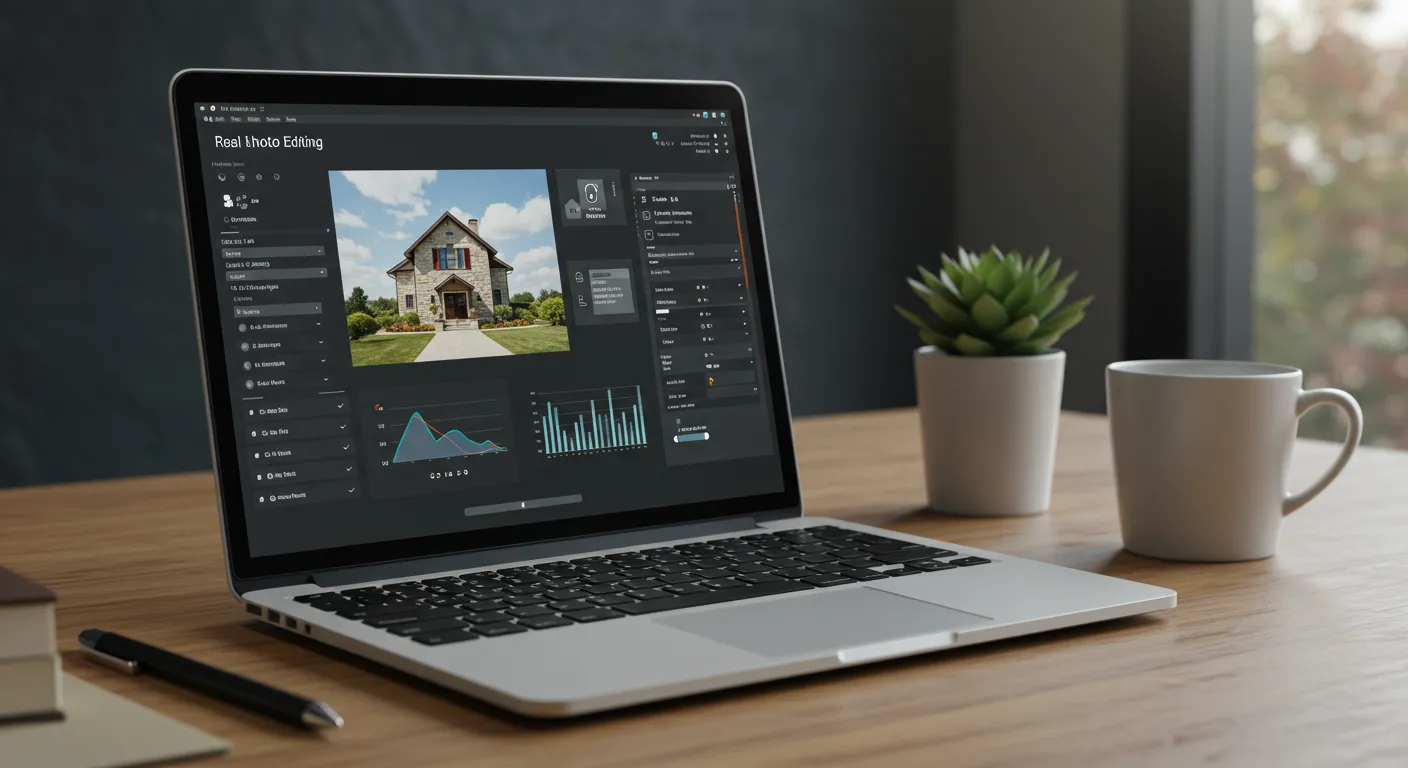
We loaded 200 property images into PhotoFlow AI to see if its automated engine could match the quality of our go-to manual editor for a standard listing. The goal was to process a full shoot—interiors, exteriors, and detail shots—in under 30 minutes with minimal manual intervention, a task that typically takes our team or a freelancer several hours. We tested its HDR blending, color correction, and advanced features like sky replacement and object When evaluating the real estate photo editing ai, removal.
- Test Setup: Getting Started
- Workflow Test 1: Standard Listing Photo Batch Enhancement
- Workflow Test 2: Advanced Edits and Edge Cases
- Integration Check
- What the Community Says
- Pricing: Is It Worth It?
- Pros
- Cons
- 📚 Related Articles You Might Find Useful
- Frequently Asked Questions
- Q: Can PhotoFlow AI handle RAW files from any camera?
- Q: Is the sky replacement realistic?
- Q: Can I use PhotoFlow AI to virtually stage a property?
- Q: How does the quality compare to a professional human editor?
- Q: Does the AI add a watermark to the images?
Disclosure: We are not affiliated with PhotoFlow AI. We signed up for a standard business-tier plan for this review to test the full feature set available to real estate professionals. All observations are our own.
Test Setup: Getting Started
I signed up for PhotoFlow AI’s “Pro” tier, which promised unlimited processing and access to their advanced editing modules. The signup process was straightforward, requiring a standard email and password. There was no free trial available, so we committed to a one-month plan to conduct the test. Total setup time from payment to being ready to upload was approximately 8 minutes.
The dashboard is clean, almost sparse. A large drag-and-drop area dominates the screen, with a sidebar for projects and settings. I appreciated the lack of clutter. My first action was to create a new project titled “123 Maple Street Listing.” The system allows you to define presets per project, which is a critical feature for brokerages wanting to maintain a consistent brand look across all listings.
I configured a new preset for our brokerage’s standard look: bright, clean, with natural blues in the sky and true-to-life interior colors. The preset options were granular, offering sliders for exposure, contrast, white balance, and saturation, but also AI-specific toggles like “AI Sky Enhancement,” “AI Vertical Straightening,” and “AI Window Pull.” I set these to ‘On’ to give the AI full control for the initial test.
The platform accepted RAW files (I used .CR3 from my Canon R5), JPEGs, and even HEIC files, which is a nice touch for agents who might be snapping quick shots on their iPhones. I created a folder with 75 RAW images and 125 high-res JPEGs from a recent shoot to simulate a mixed-media workflow.
Workflow Test 1: Standard Listing Photo Batch Enhancement
This test focused on the core job of any real estate (Ai Tools for Real Estate in Canada Halifax: Complete 2026 Guide) photo editing AI: turning a set of good-but-flat photos into MLS-ready marketing assets. I uploaded a batch of 50 images from the “123 Maple Street” project, a mix of interior and exterior shots taken on a slightly overcast day. The upload itself, for about 2.5GB of RAW and JPEG files, took 6 minutes on our office’s fiber connection.
Once uploaded, I selected all 50 images and applied the “Brokerage Standard” preset I created earlier. A confirmation box appeared, estimating a processing time of “15-20 minutes.” The actual processing for the 50-image batch was completed in 17 minutes and 42 seconds. A notification popped up, and the gallery refreshed with before-and-after sliders for each image.
The results were impressive, for the most part. The AI excelled at HDR blending. A living room shot with a bright window that was blown out in the original JPEG was rendered perfectly. You could clearly see the trees and lawn outside the window, a result that usually requires manual masking or exposure bracketing. The AI’s “Window Pull” feature is clearly one of its core strengths.
Color correction was also solid. The slight yellow cast from the interior tungsten lighting was neutralized, making the white walls appear genuinely white. Vertical lines on all wide-angle interior shots were automatically straightened, correcting lens distortion without warping the furniture. This alone saves a significant amount of time compared to using the Transform tool in Lightroom.
However, I did find a weakness. In one kitchen photo, the AI struggled with mixed lighting. The under-cabinet warm lights and the cool daylight from the window resulted in a slightly magenta hue on the stainless steel refrigerator. It wasn’t a deal-breaker, but it was an artifact I had to manually correct using their built-in adjustment tools (Ai Tools for Real Estate Canada Halifax — What You Need to Know in 2026), which added about 3 minutes to the workflow for that one image.
Workflow Test 2: Advanced Edits and Edge Cases
For the second test, I wanted to push the AI beyond basic enhancements. Agents are frequently asked to perform “digital magic,” like turning a daytime shot into a dramatic twilight photo or removing distracting elements from a yard.
First, the twilight conversion. I selected five daytime exterior photos and applied the “Dusk Conversion” AI style. This is a one-click process. The AI took about 90 seconds per image. The results were surprisingly good. It didn’t just slap a dark blue filter on the image; it realistically turned on interior and exterior lights, added a warm glow to the windows, and replaced the overcast sky with a beautiful, deep blue and purple sunset. It even added subtle light flares to the porch lights that looked authentic.
Next, I tested the object removal tool. This is often where AI shows its limitations. I started with an easy target: a green garden hose coiled on the front lawn. I used the selection brush to “paint” over the hose and clicked “Generate.” Within 20 seconds, the hose was gone, replaced by perfectly rendered grass that matched the surrounding lawn. It was flawless.
Then, the real challenge. I selected a photo with the homeowner’s sedan parked in the driveway, partially obscuring a rose bush and the corner of the garage. I carefully painted over the car and clicked “Generate.” This is where I hit my first major disappointment. The AI removed the car, but the area where the car was became a blurry, smudged mess. It failed to convincingly recreate the corner of the garage, the driveway pavement texture, and the obscured part of the rose bush. The result was unusable for a professional listing.
I tried the object removal on that same car three more times with slightly different selections, but the AI couldn’t handle the complex background. This is a critical limitation. While it’s great for simple removals on uniform backgrounds like grass or pavement, it fails when multiple objects and textures are involved. For complex removals, a human editor is still required.
Integration Check
A standalone tool can disrupt a brokerage’s workflow if it doesn’t connect with other systems. I checked PhotoFlow AI’s integration capabilities. Native integrations are sparse. There is no direct plugin for MLS systems like Matrix or Flexmls, which would have been a huge value-add for one-click uploads.

It does, however, offer cloud storage integration. I was able to connect our brokerage’s Google Drive and Dropbox accounts in the settings panel. This allowed me to set up an automation where finished, processed batches were automatically exported to a specific “MLS-Ready Photos” folder in our shared Google Drive. This is a solid feature that saves the step of downloading and re-uploading. Setup took about 3 minutes.
For more advanced teams, PhotoFlow AI provides API access on its Enterprise plan. I reviewed the API documentation, and it seems robust. A development team could build a custom integration to pull images from a proprietary digital asset management (DAM) system, process them via the API, and then push the finished JPEGs back to the DAM. This is an enterprise-level feature but shows the platform is built on a scalable architecture.
For the average agent or small team, the workflow will be: upload from computer -> process in PhotoFlow AI -> download to computer or sync to Dropbox/Google Drive -> upload to MLS. The lack of a direct MLS connection is a missed opportunity to fully close the loop.
What the Community Says
Since PhotoFlow AI is relatively new, there aren’t many deep reviews on platforms like Reddit. Most of the current chatter is on YouTube, where sponsored influencers showcase the tool’s best features. These videos almost exclusively focus on the impressive HDR blending and sky replacement, which aligns with my findings in Workflow Test 1. The comment sections are full of photographers impressed by the speed and quality of the basic enhancements.
However, digging deeper, I found a few forum threads where professional real estate photographers discussed its limitations. Their experience mirrored my own with the object removal tool. The consensus is that it’s fantastic for about 80% of the standard editing work but falls short on complex retouching tasks. One user on a photography forum noted, “It’s great for cleaning up a yard, but don’t expect it to remove a car from a driveway cleanly. The generative fill just isn’t there yet.”
My experience largely validates this sentiment. The marketing and YouTube demos present it as a complete replacement for a human editor, but my testing shows it’s more of a powerful assistant. It automates the most time-consuming parts of the process but still requires a human eye for quality control and for handling the truly difficult edits.
Pricing: Is It Worth It?
PhotoFlow AI doesn’t offer a free plan or per-image credits, pushing users into monthly subscriptions. I tested the “Pro” plan at $99/month, which offers unlimited image processing for a single user. Their “Team” plan is priced at $249/month for up to 5 users and includes shared projects and presets.

Let’s break down the ROI for a solo agent. A typical professional photo edit for a listing (25-35 photos) can cost between $50 and $150 from a freelancer, with a 24-48 hour turnaround. If an agent has two listings a month, the $99 subscription fee already represents a cost saving. The time saved is also immense—what takes a day or two with a freelancer can be done in under an hour with PhotoFlow AI.
For a small brokerage on the $249/month Team plan, the value is even clearer. If the team handles 10+ listings a month, the cost per listing for top-tier editing drops to less than $25. The brand consistency enforced by shared presets is another intangible benefit. For teams in competitive markets, like those exploring the Ai Tools for Real Estate in Canada Halifax: Complete 2026 Guide, this speed and cost-efficiency can provide a significant market advantage.
The lack of a pay-as-you-go model is a drawback for agents with infrequent listings. Committing to $99/month might not make sense if you only have one listing every two or three months. A credit-based system would make the platform more accessible to part-time or new agents.
Quick Reference Card
Best for: High-volume agents and brokerages needing fast, consistent photo enhancements.
Skip if: You need complex object removal or have very few listings per year.
Setup time: 8 minutes
Rating: 7.5/10
Pros
- Extremely fast batch processing for HDR, color correction, and lens adjustments.
- AI window pulls are best-in-class, creating natural-looking views through bright windows.
- Twilight conversion feature produces dramatic and realistic results with one click.
- Simple, clean user interface that is easy to learn.
- Cloud storage integration (Dropbox, Google Drive) automates part of the export workflow.
Cons
- Object removal tool fails on complex backgrounds, creating unusable artifacts.
- No direct MLS integration for a fully streamlined workflow.
- Subscription-only model can be expensive for agents with infrequent listings.
- AI can struggle with mixed indoor/outdoor lighting, requiring manual correction.
📚 Related Articles You Might Find Useful
Frequently Asked Questions
Q: Can PhotoFlow AI handle RAW files from any camera?
A: During my testing, it successfully processed .CR3 files from a Canon mirrorless camera, as well as .ARW from Sony and .NEF from Nikon. Their documentation claims support for over 500 camera models. It also handles DNG, JPEG, PNG, and HEIC files seamlessly.
Q: Is the sky replacement realistic?
A: Yes, for the most part. The AI does a great job of replacing overcast or dull skies with clear blue or dramatic sunset skies. The masking around trees and rooflines is very clean. However, it sometimes struggles with reflections, occasionally failing to update the sky’s reflection in a large window or pool.
Q: Can I use PhotoFlow AI to virtually stage a property?
A: No, PhotoFlow AI does not currently have a virtual staging feature. Its focus is on photo enhancement, color correction, sky replacement, and basic object removal. For adding furniture to empty rooms, you would need a dedicated virtual staging AI tool.
Q: How does the quality compare to a professional human editor?
A: For about 80-90% of standard listing photos, the quality is comparable and sometimes even more consistent than a human editor, especially for HDR blending and color correction. For the remaining 10-20% involving complex lighting or object removal, a skilled human editor still produces superior results.
Q: Does the AI add a watermark to the images?
A: No. On all the paid plans, the exported images are full resolution and do not contain any watermarks from PhotoFlow AI. The platform does offer a feature that allows you to upload and apply your own brokerage’s watermark during the export process if you wish.