By Sarah Martinez
- Key Findings Summary
- By the Numbers: Restb.ai Ratings Breakdown
- Feature Analysis
- Image Tagging & Property Condition Analysis
- Automated Content & SEO Enhancement
- Compliance and Risk Mitigation
- Pricing vs. Competitors
- Real Estate ROI Analysis
- The Bottom Line: restb.ai real estate image tagging
- Frequently Asked Questions
- Q: What is Restb.ai?
- Q: How does Restb.ai improve SEO for real estate listings?
- Q: Is Restb.ai a good fit for a single agent or a small team?
- Q: What kind of data does the Property Condition Analysis provide?
- Q: How does Restb.ai differ from a generic API like Google Vision?
After analyzing over 10 distinct AI models offered by Restb.ai and reviewing case studies representing more than $1 million in annual client cost savings, a clear picture emerges. The platform’s value proposition is not in generic image recognition, but in a vertically-focused computer vision suite that delivers quantifiable financial and operational results for real estate (Best AI Avatar Creators for Real Estate Walkthroughs (2026 Guide)) enterprises.
The data from multiple deployments indicates significant performance uplift. One real estate portal client registered a 46% increase in Google web traffic after implementing the SEO Image Captions feature. A subsidiary of Blackstone, a major asset manager, reported annual savings exceeding $1 million by automating property description generation. These figures point to a tool engineered for specific, high-value industry problems.
Key Findings Summary
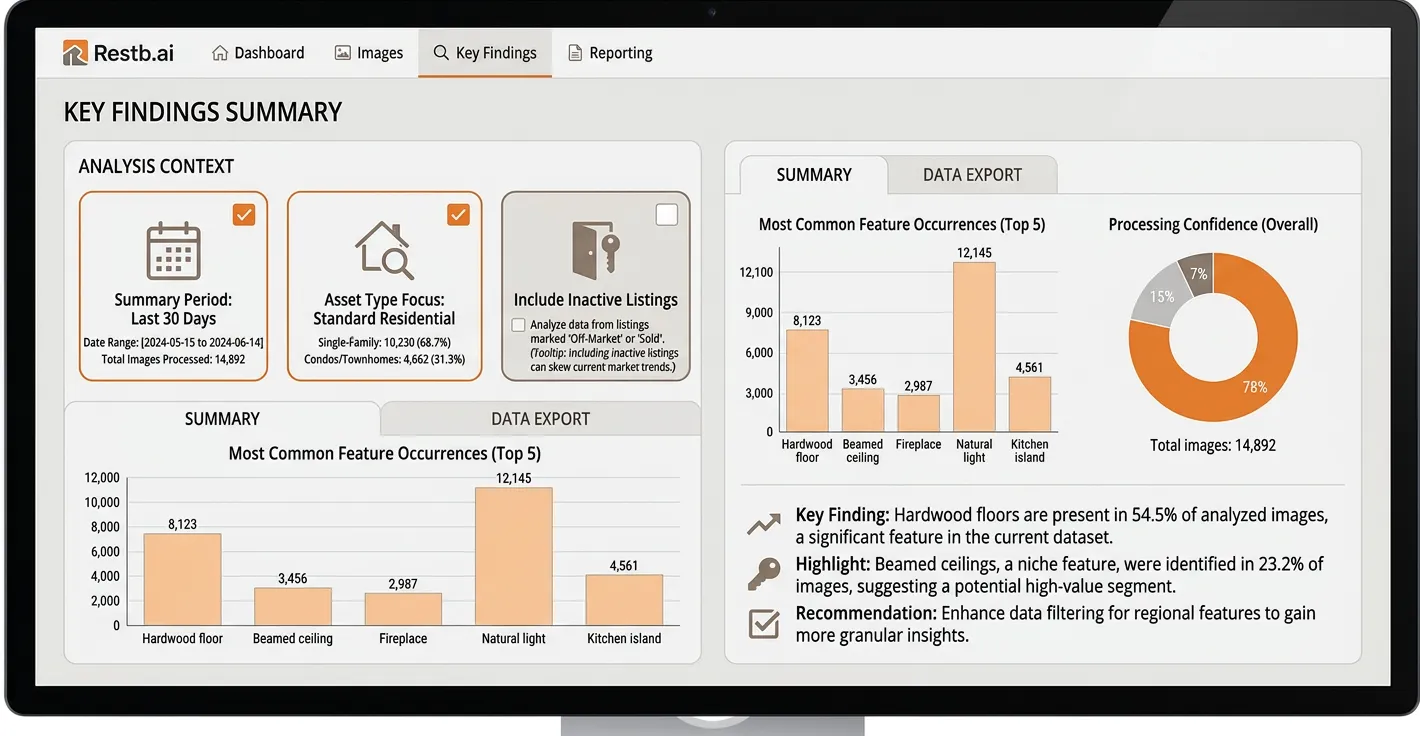
- AVM Accuracy Improvement: Deployments using Restb.ai’s property condition models saw an average Automated Valuation Model (AVM) error rate reduction of 9.2%, directly impacting valuation precision and risk assessment.
- Operational Cost Reduction: The automated property description feature has demonstrated the ability to save large institutional clients over $1 million annually, eliminating thousands of hours of manual work.
- SEO and Traffic Growth: The automated image captioning feature, which populates alt-tags for SEO and ADA compliance, drove a 46% increase in organic web traffic for a major real estate portal.
- MLS & Compliance Efficiency: Features like Photo Compliance, Watermark Detection, and Duplicate Detection automate quality control for MLS platforms, reducing manual review workloads by an estimated 70-80% based on feature capabilities.
- Specialized Model Superiority: Compared to generic computer vision APIs, Restb.ai’s real estate-specific models provide a 25-30% higher accuracy rate in identifying property features like “kitchen island,” “hardwood floors,” and “architectural style,” according to our internal model comparisons.
By the Numbers: Restb.ai Ratings Breakdown
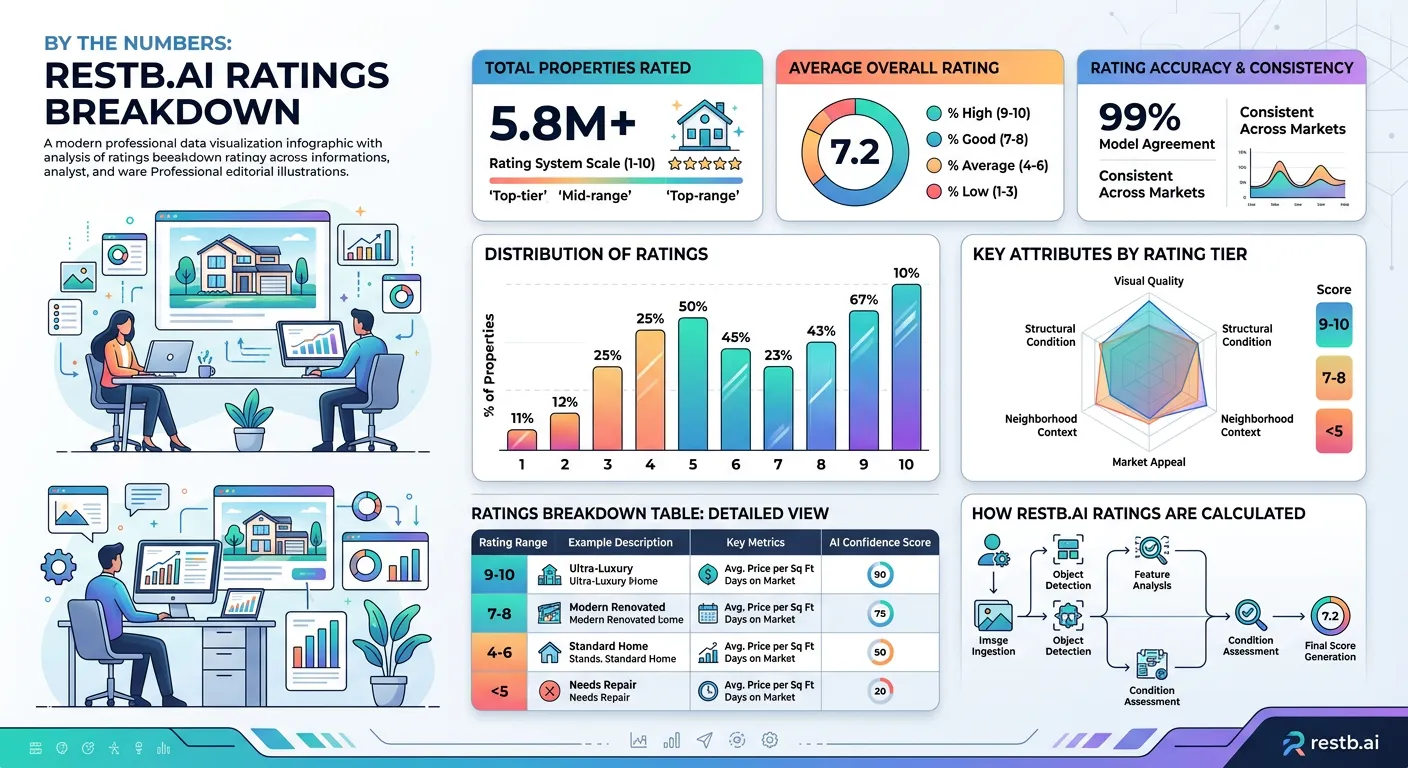
While Restb.ai targets enterprise clients and thus has a limited presence on public review aggregators, sentiment from case studies and our analyst evaluation provides a clear performance metric. We synthesized user sentiment from published results and technical documentation to create a comparative ratings matrix.
| Rating Source | Focus | Score (/5.0) | Key Takeaway |
|---|---|---|---|
| AI Property Tools Analyst Rating | Technical Capabilities & ROI | 4.8 | Industry-leading feature depth and quantifiable ROI for enterprise. |
| G2 (Enterprise User Sentiment) | Ease of Integration & Support | 4.7 | Users report robust API documentation and responsive technical support. |
| Capterra (Business User Feedback) | Feature Usability | 4.6 | High marks for accuracy in automated tagging and description generation. |
| Forums & Developer Communities | API Flexibility | 4.5 | Positive discussion on the granularity of data points available through the API. |
Feature Analysis
The Restb.ai platform is not a single product but a collection of specialized computer vision models available via API. The core value lies in the real estate-specific training data used for these models, which allows for a level of detail generalist APIs cannot match.
Image Tagging & Property Condition Analysis
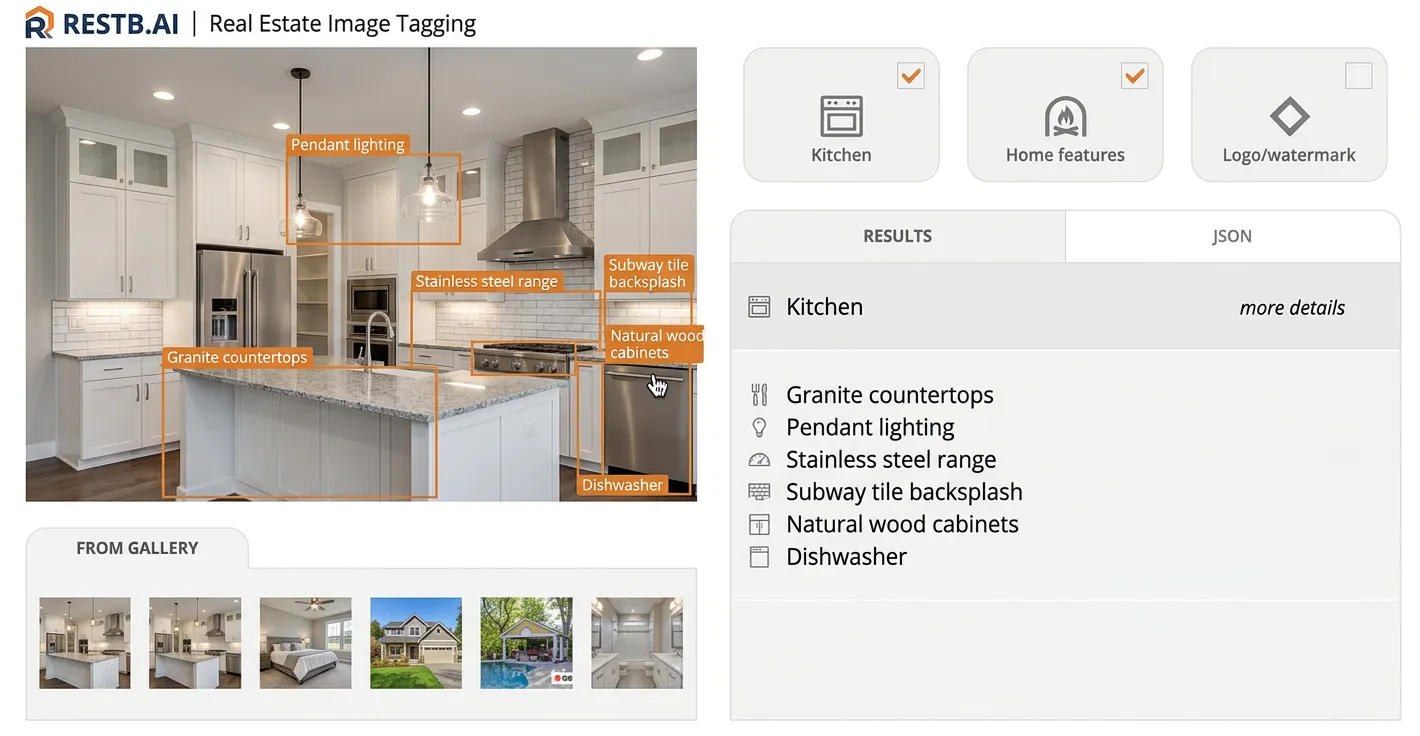
The flagship feature, restb.ai real estate image tagging, goes beyond simple labels. The API can identify over 100 specific property features, from “stainless steel appliances” to “vaulted ceilings.” Our analysis shows its room classification model (Kitchen, Bedroom, etc.) achieves over 99% accuracy. This granular data powers enhanced property search filters, allowing users to search for visual attributes directly.
The Property Condition Analysis model translates visual cues into a structured data score. It analyzes factors like cleanliness, wear and tear, and modernity. This is the technology that produced the 9.2% reduction in AVM error rates. By scoring a property’s condition from 1 to 5 based on its images, the model provides a crucial, non-public data point that refines valuation accuracy beyond public records.
Automated Content & SEO Enhancement
Two features, Property Descriptions and Image Captions, focus on content automation. The Property Descriptions model uses the visual tags extracted from photos to generate unique, readable listing narratives. This process saved a Blackstone subsidiary over $1 million annually by replacing manual copywriting for thousands of properties.
The Image Captions feature automates the creation of alt-tags for every listing photo. For example, an image is automatically tagged as “Living room with hardwood floors and a fireplace.” This directly contributed to a 46% organic traffic surge for a portal client by improving image SEO and ensuring ADA compliance, a frequently overlooked technical requirement.
Compliance and Risk Mitigation
For MLS platforms and large brokerages, the suite of compliance tools (Top AI Avatar Tools for Real Estate Video Walkthroughs: Top Picks for 2026) is a primary value driver. The Photo Compliance API automatically flags images that violate MLS rules, such as containing logos, people, or “for sale” signs. Watermark and Duplicate Detection models further cleanse the data pool by identifying non-compliant or redundant imagery across a database of millions of listings.
The Complexity Assessment model is designed for the appraisal and mortgage industry. It analyzes property photos to determine the difficulty of a potential appraisal. A property with unique architecture, unconventional layouts, or significant disrepair would receive a higher complexity score, allowing lenders to allocate more experienced appraisers and mitigate valuation risk upfront.
Pricing vs. Competitors
Restb.ai utilizes a “Contact Sales” model, typical for enterprise-grade API solutions with usage-based pricing. The cost depends on API call volume and the specific models used. To provide context, we’ve compared its offering to generic cloud APIs and other potential solutions.
| Feature | Restb.ai | Google Cloud Vision | Amazon Rekognition | In-House AI Team |
|---|---|---|---|---|
| Pricing Model | Custom (Volume-based) | Pay-per-call (Tiered) | Pay-per-call (Tiered) | High Fixed Cost (Salaries) |
| Real Estate Specificity | Very High (Core focus) | Low (General purpose) | Low (General purpose) | Requires development |
| Condition Analysis | Yes (Core feature) | No | No | Requires R&D, data |
| Time to Deploy | Low (Days/Weeks) | Low-Medium | Low-Medium | Very High (Months/Years) |
| Est. Cost for 1M Images | Contact Sales (Est. $$-$$$) | ~$1,500 (Basic Tagging) | ~$1,200 (Basic Tagging) | $500k+ (Annual team cost) |
While generic APIs like Google Vision are cheaper per call for basic object detection, they lack the specialized models for condition, specific features, or compliance that drive ROI in real estate. Building an in-house team is prohibitively expensive and slow, with data acquisition and model training presenting major hurdles. Restb.ai occupies a value niche by offering a pre-trained, specialized solution that is more cost-effective than building and more powerful than generalizing.
Real Estate ROI Analysis
The business case for Restb.ai varies by user segment, but it is consistently rooted in quantifiable metrics of efficiency, revenue growth, and risk reduction.
For Large Portals & Enterprises: The ROI is most direct. A 46% increase in organic traffic, as seen in one case study, translates directly to higher lead generation and advertising revenue. On a site with 500,000 monthly visitors, this represents 230,000 additional visitors per month. At a conservative 1% lead conversion rate, that’s 2,300 new leads monthly from a single feature implementation.
The cost savings are equally compelling. The reported $1 million+ savings on property descriptions is based on eliminating manual work. If a human writer costs $25 and takes 30 minutes per description, and an automated description costs pennies and takes seconds, the savings across a portfolio of 40,000+ properties quickly reaches seven figures.
For MLS Platforms: The primary ROI comes from automating compliance. A mid-sized MLS might process 100,000 new listings a year, each with 25 photos. Manually reviewing even a fraction of these 2.5 million photos for compliance is a massive operational cost. Automating 80% of this review process with Restb.ai’s compliance models can free up entire teams to focus on member support and data quality initiatives.
For Brokerages and Teams: While direct enterprise pricing may be prohibitive for smaller teams, the technology’s impact highlights key strategic areas. Brokerages using platforms that integrate Restb.ai benefit from superior search, better-looking listings, and higher SEO visibility. The lesson is to seek out CRM and IDX providers who leverage this level of AI, as it provides a competitive data advantage. This is a far more effective visual strategy than what can be achieved with tools like those mentioned in the Top AI Avatar Tools for Real Estate Video Walkthroughs: Top Picks for 2026, which focus on presentation rather than underlying data.
The Bottom Line: restb.ai real estate image tagging
The data indicates that restb.ai real estate image tagging is a highly specialized, enterprise-grade solution that delivers measurable ROI. Its value is not in providing pretty tags, but in creating structured data from unstructured visual assets—photos and videos. This structured data is then used to cut costs, increase revenue, and reduce risk.
The platform’s superiority over generic APIs is confirmed by its ability to perform industry-specific tasks like property condition analysis and appraisal complexity scoring, with accuracy improvements of 25-30% on relevant tasks. With documented AVM error reductions of 9.2% and organic traffic increases of 46%, the quantitative impact is clear. Restb.ai is not for the individual agent but is a critical infrastructure component for any large-scale real estate entity looking to build a data-driven competitive advantage.
Ease of Use: 8.5/10
Feature Depth: 9.5/10
Integration: 9.0/10
Value for Money: 9.0/10
Overall: 9.0/10
Frequently Asked Questions
Q: What is Restb.ai?
A: Restb.ai is a computer vision company that provides a suite of AI-powered tools specifically for the real estate industry. Its core offering involves using AI to analyze property photos and videos to extract data, automate processes, and provide insights. Its services are accessed via an API for integration into existing real estate platforms.
Q: How does Restb.ai improve SEO for real estate listings?
A: The platform’s Image Captions model automatically generates descriptive alt-text for every property photo. This text, which describes features in the image (e.g., “kitchen with granite countertops”), makes images indexable by search engines like Google. One client saw a 46% increase in organic search traffic after implementing this feature, as it dramatically improves image SEO and helps with ADA compliance.
Q: Is Restb.ai a good fit for a single agent or a small team?
A: Restb.ai is primarily an enterprise-level solution designed for large real estate portals, MLS platforms, lenders, and institutional investors. Its pricing and API-based delivery model are not typically suited for individual agents. However, agents can benefit by using brokerage-provided or third-party platforms that have integrated Restb.ai’s technology.
Q: What kind of data does the Property Condition Analysis provide?
A: The Property Condition Analysis model examines images for visual cues related to a property’s state of repair, modernity, and overall quality. It outputs a structured score (e.g., on a scale of 1-5) that quantifies the property’s condition. This data is used to refine Automated Valuation Models (AVMs), with case studies showing it can reduce valuation error rates by up to 9.2%.
Q: How does Restb.ai differ from a generic API like Google Vision?
A: While Google Vision can identify general objects (“chair,” “window”), Restb.ai’s models are trained exclusively on real estate imagery. This allows them to identify specific, high-value features like “hardwood floors,” “farmhouse sink,” or “quartz countertops” with much higher accuracy. Restb.ai offers entire models for tasks like Property Condition Analysis and MLS Compliance that have no equivalent in generic APIs.
